From Bottleshop to EveryBottle
Product discovery and strategy that challenged a founder's initial SaaS concept and uncovered a new opportunity
Timeline: Fall 2025 – Summer 2026
Role: Product Strategist + UX Designer
Additional ownership: Client lead / day-to-day account partner
Brand + UI Visual Design: Dmitrii Tereshchenko, Sam Flaherty
The starting point
The founder of Playlist, an established wine events company, came to us with an idea for Bottleshop: an AI-powered SaaS platform for independent wine and spirits retailers. Having previously built and sold two companies, he saw an opportunity to modernize a traditionally fragmented industry.
The premise made sense on paper. Product information was fragmented, retailers spent significant time researching inventory and creating marketing content, and many relied on disconnected or manual systems. Bottleshop aimed to streamline work through enriched product data, automated content, and more personalized marketing.

Testing the premise before designing the solution
Before moving into design, I recommended validating whether the problem was painful enough to justify building the product at all.
I led discovery with seven retailers, distributors, winery professionals, and other industry experts to understand how they brought new inventory to market and where workflows broke down.
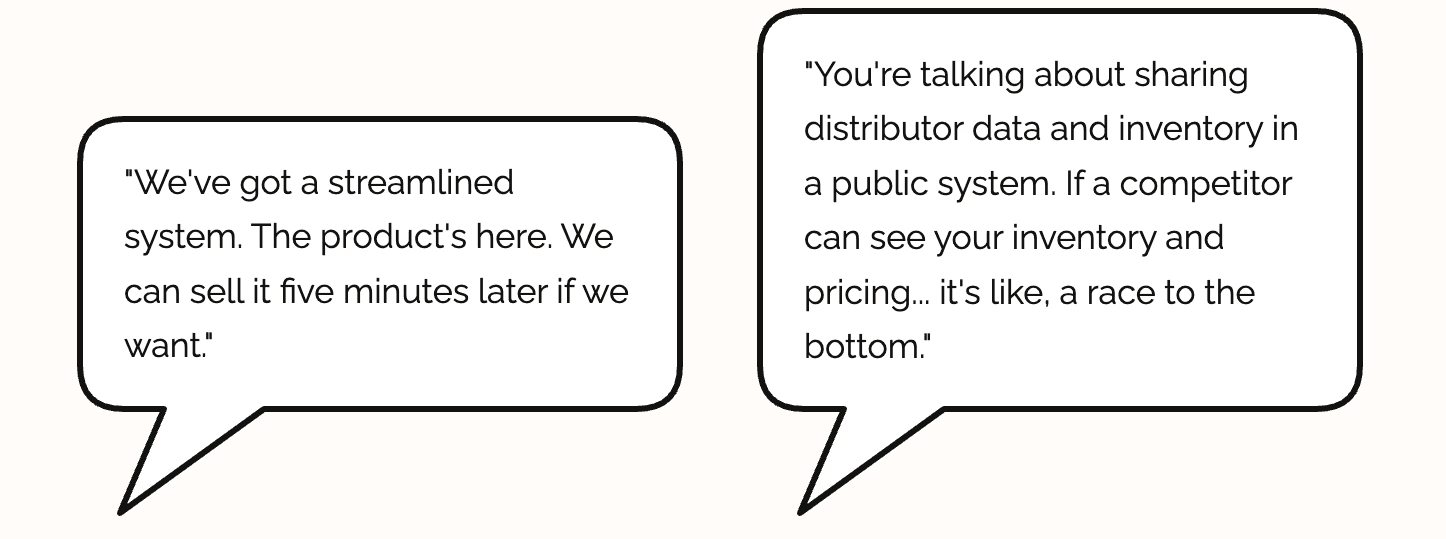
The original hypothesis didn't hold consistently. Some businesses already had software that worked well enough and saw our proposed features as nice-to-haves. Others were highly manual, even pen-and-paper, but had little interest in adopting new software. Those who did see a need showed how complex a unified solution would be.
The industry’s fragmentation was real. But fragmentation alone wasn’t a strong enough reason to build another SaaS platform.

What we heard instead
The conversations challenged our original premise, while also revealing something more interesting.
People across the industry cared deeply about the stories, people, places, and knowledge behind what they sold. One retailer described education, community, and storytelling as central to his business, often researching producers, history, regions, and even soil beyond the information supplied with a bottle.
Other conversations surfaced challenges around declining interest in wine in some markets, inconsistent product education, and unpredictable ways for people across the industry to connect and discover what was new. Wine remained highly relationship-driven and analog, with much of its knowledge living in individual expertise, in-person experiences, and informal communities.
At the same time, our research into Bottleshop had exposed another underlying issue: bottle information itself was scattered across producers, importers, distributors, retailers, websites, spreadsheets, and individual knowledge. The information existed, but there wasn't a single, engaging place built around understanding and exploring it.
The research didn't tell us there was no opportunity in wine. It told us we may have been starting in the wrong place.

From software tool to ecosystem
Rather than asking retailers and distributors to adopt another operational system, what if we started with the thing people were already passionate about: the bottles themselves?
I pushed us to rethink the entry point, leading with discovery and shared knowledge rather than operational pain. Through exploration with the founder, that direction evolved into a community-built “wiki” for wine, built around discovering bottles and producers, contributing knowledge, and connecting with others.
A trusted knowledge layer, combined with what people explored and loved, could eventually support personalized recommendations, education, and tools for local shops and restaurants, without requiring businesses to adopt a new operating system upfront.
That direction became EveryBottle. From there, the founder and I worked closely together to define the product.

Turning the strategy into a product
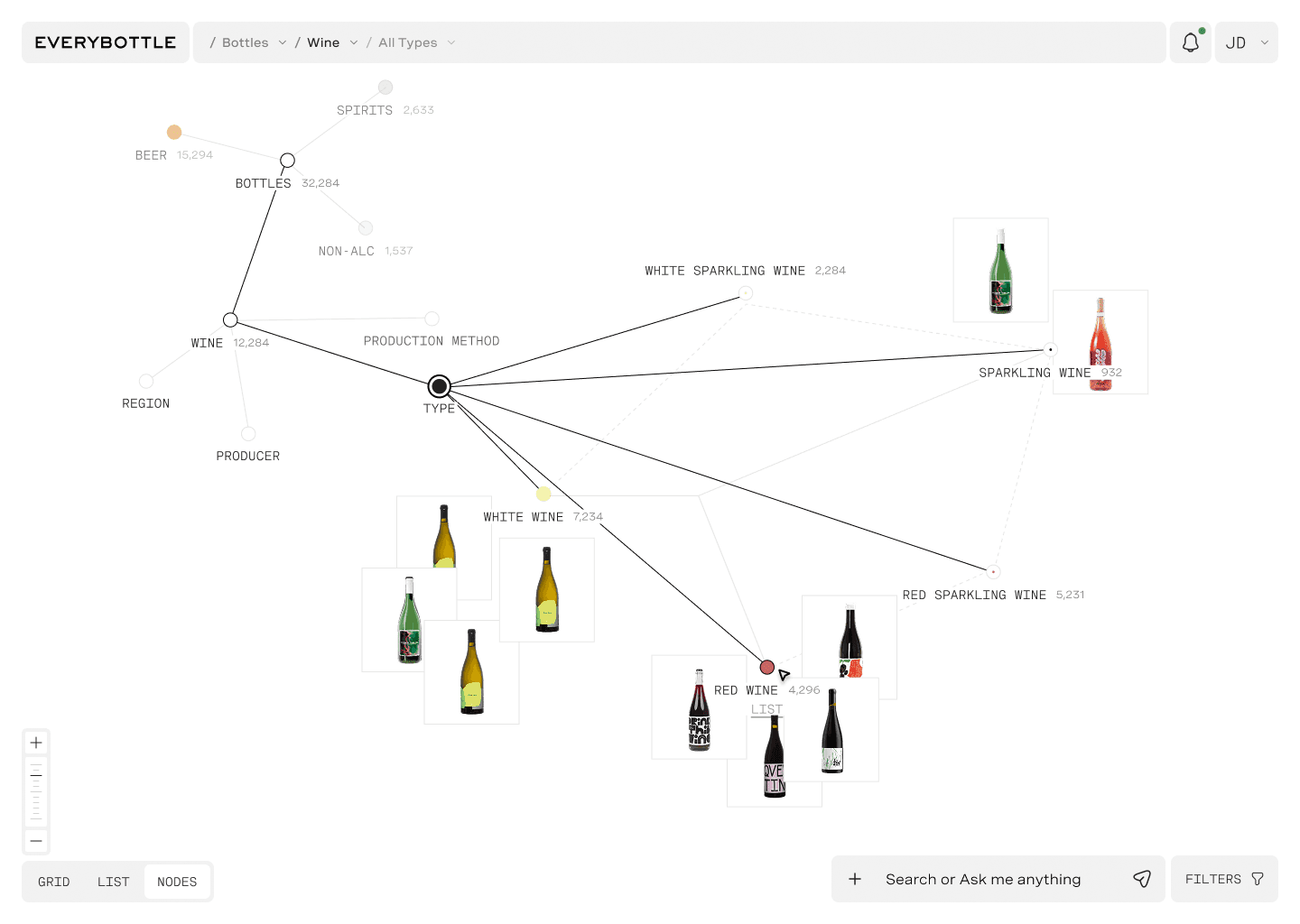
EveryBottle became a community-built encyclopedia of wines, spirits, beer, and beyond: a place to browse, learn, contribute, and expand a shared catalog.
I co-owned product definition with the founder, translating the concept into the PRD, sitemap, information architecture, features, and core user flows.
The experience was designed around a few central behaviors: Discover: Browse bottles through categories, regions, producers, grapes, search, filters, and interconnected views. Learn: Move beyond a basic SKU into the people, provenance, geography, and context behind a bottle. Contribute: Add missing bottles, correct information, and build the collective record. Trust: Use community moderation to review contributions and protect the quality of the data. Explore: Use AI as an enabling layer for search and discovery, not as the reason the product exists.


Partnering through Design
I partnered closely with visual designer Dmitrii [Last Name] throughout high-fidelity design. While Dmitrii led the visual system and high-fidelity execution, I stayed deeply involved in each iteration, reviewing flows, identifying interaction and usability gaps, refining UX copy, recommending UI changes, and making sure individual screens continued to work as a coherent product.
As the day-to-day client lead, I also served as the bridge between founder feedback and design, translating evolving product needs into clear direction as we moved from concept to final designs.



Where we landed
By Summer 2026, we had moved from an initially defined AI SaaS product to a fundamentally different product direction, one grounded in what we learned about the people and ecosystem we were designing for.
The work helped the team: avoid investing further in a weakly validated SaaS MVP; uncover and articulate a more differentiated opportunity; create a product direction that aligned more naturally with Playlist’s existing community; define an MVP and complete product experience; establish a foundation that could eventually connect consumers, product knowledge, and local businesses in more personalized ways.
The founders are now building EveryBottle, with an early version of the product live.